Lang
Lang

![[image_name]](https://images.theconversation.com/files/400905/original/file-20210516-13-tig4sq.jpg?ixlib=rb-1.1.0&q=45&auto=format&w=600&h=413&fit=crop&dpr=1)
![[image_name]](https://images.theconversation.com/files/400875/original/file-20210516-15-mu2kgi.png?ixlib=rb-1.1.0&q=45&auto=format&w=600&h=257&fit=crop&dpr=1)
![[image_name]](https://images.theconversation.com/files/374066/original/file-20201210-19-1sac9wo.png?ixlib=rb-1.1.0&q=45&auto=format&w=600&h=395&fit=crop&dpr=1)
While U.S. Secretary of State Antony Blinken draws attention to climate change in the Arctic at meetings with other national officials this week in Iceland, an even greater threat looms on the other side of the planet.
New research shows it is Antarctica that may force a reckoning between the choices countries make today about greenhouse gas emissions and the future survival of their coastlines and coastal cities, from New York to Shanghai.
That reckoning may come much sooner than people realize.
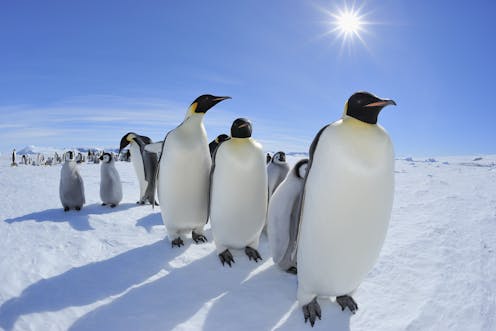
The Arctic is losing ice as global temperatures rise, and that is directly affecting lives and triggering feedback loops that fuel more warming. But the big wild card for sea level rise is Antarctica. It holds enough land ice to raise global sea levels by more than 200 feet (60 meters) – roughly 10 times the amount in the Greenland ice sheet – and we’re already seeing signs of trouble.
Scientists have long known that the Antarctic ice sheet has physical tipping points, beyond which ice loss can accelerate out of control. The new study, published in the journal Nature, finds that the Antarctica ice sheet could reach a critical tipping point in a few decades, when today’s elementary school kids are raising their families.
The results mean a common argument for not reducing greenhouse gas emissions now – that future technological advancement can save us later – is likely to fail.
The new study shows that if emissions continue at their current pace, by about 2060 the Antarctic ice sheet will have crossed a critical threshold and committed the world to sea level rise that is not reversible on human timescales. Pulling carbon dioxide out of the air at that point won’t stop the ice loss, it shows, and by 2100, sea level could be rising more than 10 times faster than today.
Antarctica has several protective ice shelves that fan out into the ocean ahead of the continent’s constantly flowing glaciers, slowing the land-based glaciers’ flow to the sea. But those shelves can thin and break up as warmer water moves in under them.
As ice shelves break up, that can expose towering ice cliffs that may not be able to stand on their own.
There are two potential instabilities at this point. Parts of the Antarctic ice sheet are grounded below sea level on bedrock that slopes inward toward the center of the continent, so warming ocean water can eat around their lower edges, destabilizing them and causing them to retreat downslope rapidly. Above the water, surface melting and rain can open fractures in the ice.
When the ice cliffs get too tall to support themselves, they can collapse catastrophically, accelerating the rate of ice flow to the ocean.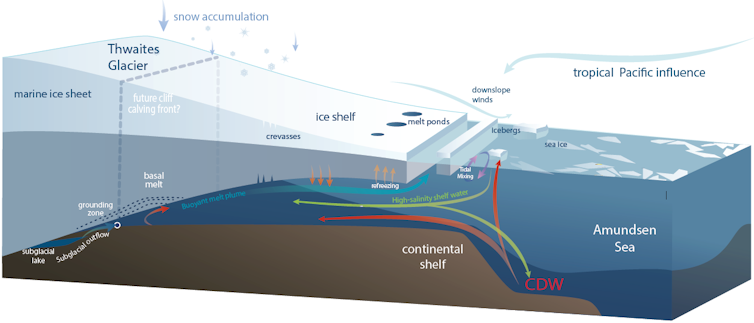
Some other researchers suggest that ice cliffs in Antarctica might not collapse as quickly as those in Greenland. But given their size and current rates of warming – far faster than in the historic record – what if they instead collapse more quickly?
As countries prepare to increase their Paris Agreement pledges in the runup to a United Nations meeting in November, Antarctica has three important messages that we would like to highlight as polar and ocean scientists.
First, every fraction of a degree matters.
Second, allowing global warming to overshoot 2 C is not a realistic option for coastal communities or the global economy. The comforting prospect of technological fixes allowing a later return to normal is an illusion that will leave coastlines under many feet of water, with devastating economic impacts.
Third, policies today must take the long view, because they can have irreversible impacts for Antarctica’s ice and the world. Over the past decades, much of the focus on rapid climate change has been on the Arctic and its rich tapestry of Indigenous cultures and ecosystems that are under threat.
As scientists learn more about Antarctica, it is becoming clear that it is this continent – with no permanent human presence at all – that will determine the state of the planet where today’s children and their children will live.
Source : The Conversation